
Par Orsha Magyar, M. Sc., C.H.N.
Des micronutriments micro mais costauds!
Les micronutriments sont des vitamines et des minéraux, mais ne vous laissez pas tromper par le mot « micro ». Ce n’est pas parce que notre corps en a besoin en très petites quantités, ou « micro », qu’ils ne sont pas costauds!
Ils sont des cofacteurs essentiels dans des milliers de réactions cellulaires et de voies biochimiques vitales pour la vie. Voici quelques exemples de la façon dont les vitamines et les minéraux influencent notre cerveau et notre santé mentale :
Production d’ATP (adénosine triphosphate, l’énergie de nos cellules)
- Vitamines B, vitamine C
- Magnésium, potassium, fer
Production de neurotransmetteurs
- Vitamines B, vitamines C et D
- Iode, zinc, sélénium
Production d’hormones
- Vitamines B, vitamines C, D et E
- Calcium, fer, iode, magnésium, sélénium, zinc
Neurosciences nutritionnelles 101
Un domaine de recherche fascinant appelé neuroscience nutritionnelle nous apprend que ce que nous mangeons a un impact très réel sur notre cerveau et notre santé mentale.
Les scientifiques qui travaillent dans ce domaine révèlent que ce que nous mangeons affecte notre santé neurologique et psychiatrique parce que les vitamines et les minéraux jouent des rôles très importants dans :
- La production de neurotransmetteurs
- La synthèse hormonale (y compris les hormones du stress, nous aborderons le stress plus tard)
- La communication entre l’intestin et le cerveau
- La neuroplasticité (la capacité du cerveau à développer de nouveaux neurones)
- Le stress oxydatif (c’est-à-dire les dommages causés par les radicaux libres)
- L’inflammation et la neuroinflammation (il s’agit de l’inflammation dans le cerveau, par exemple, après une lésion cérébrale comme une commotion cérébrale ou un accident vasculaire cérébral ou une maladie cérébrale comme la maladie d’Alzheimer)
Le stress : Le voleur silencieux de micronutriments
Lorsque nous sommes stressés, beaucoup de choses se produisent que nous pouvons voir : irritabilité, mauvaise humeur, brouillard mental, difficulté à se concentrer ou à se souvenir, perte d’appétit ou appétit vorace. Mais le stress fait aussi beaucoup de choses invisibles à notre corps (jusqu’à ce qu’elles se manifestent sous forme de déséquilibres).
Le stress peut augmenter notre besoin en micronutriments et épuiser nos réserves de vitamines et de minéraux en :
- Réduisant notre capacité à les absorber
- Interférant avec notre capacité à les traiter
- Augmentant leur excrétion
À titre d’exemple, lorsque nous sommes stressés, nos reins le sont aussi. Et leur symptôme de stress est la confusion. Au lieu de filtrer les vitamines B bonnes pour le cerveau et le magnésium anti-anxiété dans le sang, ils les filtrent dans l’urine, de sorte que nous les excrétons.
La gestion du stress est un outil essentiel pour déstresser non seulement votre cerveau, mais aussi votre corps (et l’aider à conserver des micronutriments importants).
Manger pour la santé du cerveau
La psychiatrie nutritionnelle met en pratique les connaissances issues de la neuroscience nutritionnelle. Elle comprend que la nutrition influence la structure et la fonction de votre cerveau, et finalement votre humeur. Et elle vise à aider les gens à améliorer leur santé mentale avec des aliments complets riches en nutriments essentiels pour le cerveau, notamment :
- Acides gras oméga-3
- Probiotiques et prébiotiques
- Antioxydants (par ex., vitamines A, C, E)
- Vitamines B et vitamine D
- Magnésium, fer et zinc
Elle se concentre également sur la réduction des aliments qui, selon la science, ont un impact négatif sur la santé du cerveau et la santé mentale, comme le sucre, les gras trans et les aliments transformés et raffinés.
Des suppléments pour améliorer la santé du cerveau
Beaucoup de gens ne consomment tout simplement pas un nombre optimal de micronutriments ou ont des besoins plus élevés à différentes étapes et phases de la vie. Votre mode de vie peut également augmenter la demande en vitamines et minéraux (bonjour, le stress!). Les médicaments peuvent également favoriser l’épuisement nutritionnel, tout comme les antinutriments tels que les oxalates, les phytates et même les tanins (désolé, le vin rouge).
De plus, les déséquilibres de la santé mentale et une mauvaise alimentation vont de pair. Lorsqu’une personne souffre de problèmes de santé mentale, il peut devenir difficile d’adopter une alimentation saine pour le cerveau qui nécessite de faire des listes d’épicerie, de faire les courses et de préparer les repas.
Ainsi, bien que l’alimentation soit primordiale dans une approche diététique de la santé mentale, des suppléments clés fondés sur des preuves peuvent également être envisagés.
Une approche en 3 piliers des neurosciences nutritionnelles en matière de santé mentale combine un soutien fondamental en micronutriments avec des micronutriments ciblés en fonction des besoins individuels. J’aime souvent recommander des suppléments faciles à digérer qui associent des aliments entiers à des micronutriments d’une manière que le corps reconnaît facilement. Voici mes choix de MegaFood pour la santé mentale et l’équilibre de l’humeur :
PILIER 1 : Micronutriments fondamentaux
Une multivitamine fondamentale pour la santé du cerveau peut être essentielle pour de nombreuses personnes qui manquent d’éléments essentiels en raison de besoins accrus, de stress élevé et d’autres facteurs.
Les multivitamines sont controversées parce qu’elles contiennent des doses plus faibles de micronutriments que celles qui se sont avérées cliniquement efficaces. Mais de petites quantités de nombreuses vitamines et minéraux sont nécessaires dans des voies importantes pour la santé mentale, comme la production de sérotonine (puis sa conversion en mélatonine) et la transformation de l’acide gras oméga-3 ALA d’origine végétale en EPA et DHA (qui sont ceux nécessaires à la santé du cerveau et à la santé mentale).
PILIER 2 : Vitamines ciblées
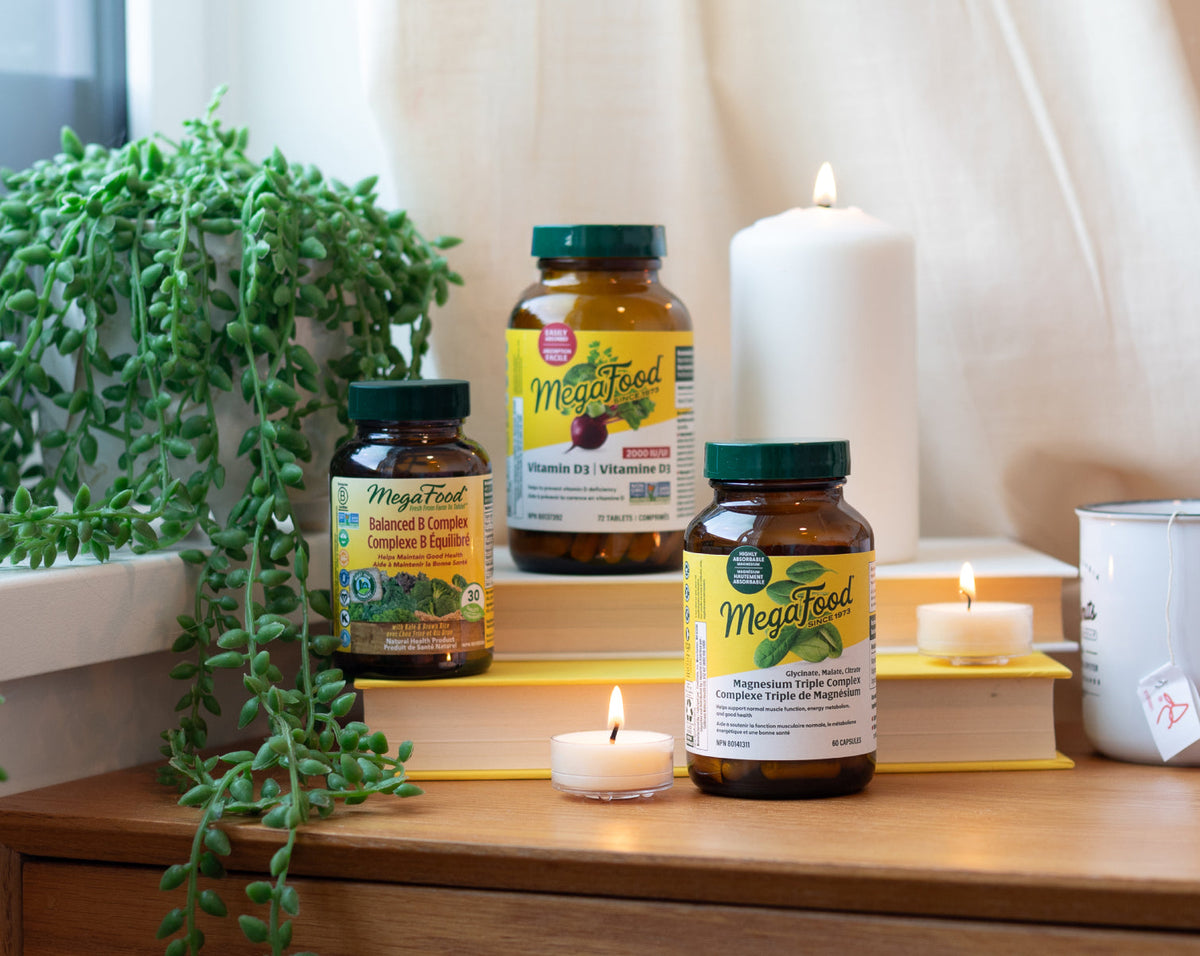
Les vitamines clés, à savoir le complexe B et la vitamine D, peuvent offrir un soutien neuro-nutritionnel aux personnes ayant des carences et diverses préoccupations en matière de santé mentale.
PILIER 3 : Minéraux ciblés
La recherche suggère que certains minéraux, comme le fer et le magnésium pour la santé du cerveau, peuvent également offrir un soutien à ceux qui recherchent une approche nutritionnelle.
Les micronutriments sont « micro » mais ils sont vraiment costauds, et un domaine d’intérêt croissant dans une approche holistique de la santé du cerveau et de la santé mentale.
